
行尸走肉第三季
Grassroots official’s 30-year fight against desertification in North China_我的网站

一 |
Ecological restoration
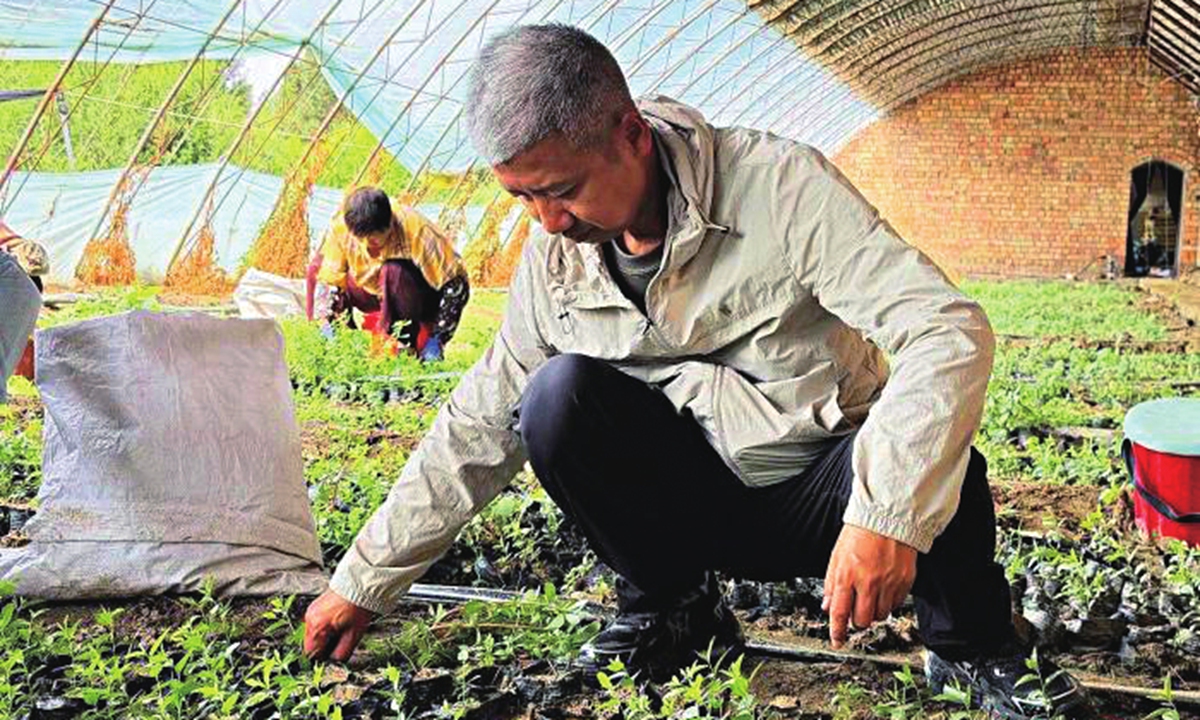
For over 30 years, Wensuyalatu, a member of the leadership group of the Urad Rear Banner forestry and grassland bureau, has made the Gobi Desert his workplace, dedicating his life to combating desertification, advancing ecological restoration through technological innovation, and helping local herders increase their incomes, according to the local bureau's official WeChat account.
Located on the edge of the desert in Bayannur's Urad Rear Banner, it is a key area in China's Three-North Shelterbelt Forest Program, a major ecological project aimed at strengthening the country's northern ecological security barrier.
However, early afforestation efforts in the desert were far from easy at the start.
The project covers 103,800 mu (about 6,920 hectares), including comprehensive treatment of 24,500 mu of desertified land, ecological restoration of 4,100 mu of non-desertified land, and 75,200 mu of enclosed grassland restoration. The project also includes the construction of 11 small-scale water conservation facilities, all of which required strict standards and extensive coordination.
The project also includes the construction of 11 small-scale water conservation facilities, all of which required strict standards and extensive coordination.
In 1991, Wensuyalatu, then in his early 20s, chose to devote himself to forestry and grassland conservation in the Urad Rear Banner. Since then, he has remained on the front lines of desertification control, witnessing the region's harshest environmental challenges and working to find solutions adapted to the fragile desert ecosystem.
In the early years, afforestation in the Gobi Desert was an extremely difficult task. The most critical planting season in spring often coincided with the strongest sandstorms of the year. Every year during the key afforestation period, Wensuyalatu would stay deep in the desert, guiding workers on planting techniques and management practices, while carefully overseeing every detail of the ecological restoration projects.
"Every spring, the wind and blown sand were so strong that it was hard to keep your eyes open. The sand hit your face like needles. During the day, we followed workers to dig holes and plant trees, and at night we stayed in temporary shelters to organize data and review the day's work. That was the normal routine for desertification fighters," Wensuyalatu recalled.
The road to restoring the desert was far from easy. Years of drought, low survival rates of seedlings, and skepticism from some local residents created major obstacles.
"At the beginning, it was really difficult. The climate was extremely dry, and many seedlings died after being planted. Some herders did not understand or support the work. They believed deserts were naturally barren and that no amount of effort could make trees grow there," Wensuyalatu said.
To change these perceptions, Wensuyalatu brought local residents to see firsthand the damage caused by desert expansion. Through visible results and long-term communication, he gradually won the understanding and support of the community.
Facing the ecological challenges of the Urad Rear Banner, Wensuyalatu began exploring new approaches beyond traditional restoration methods.
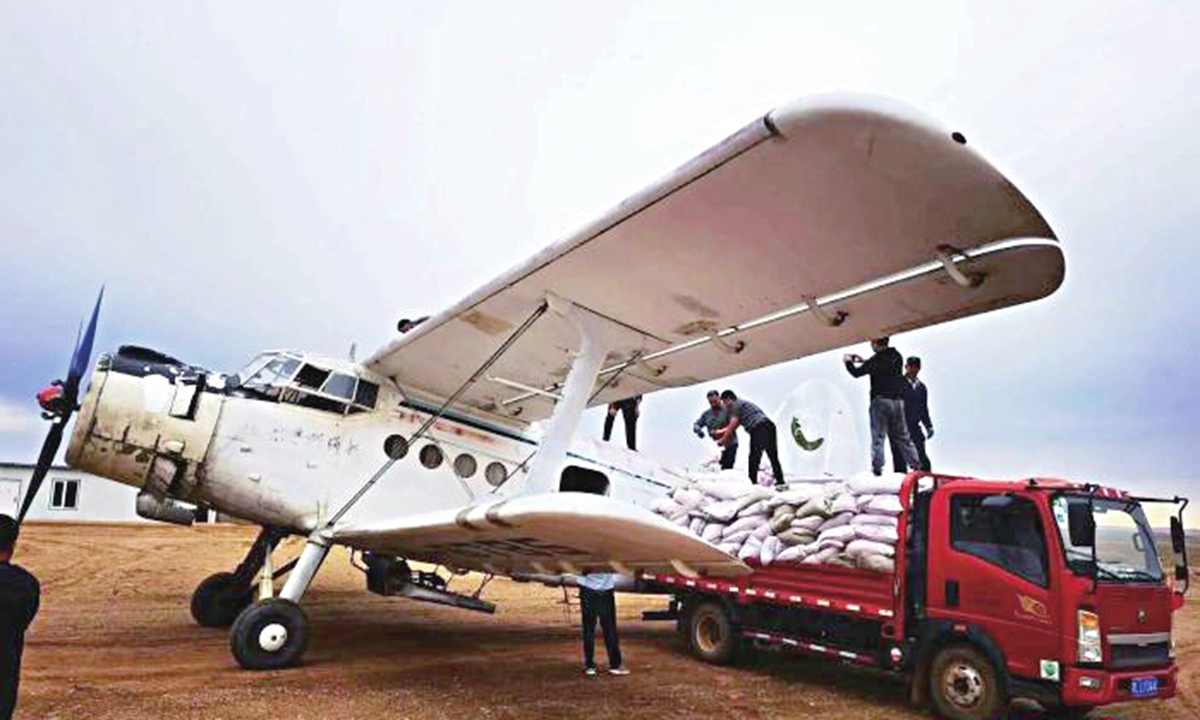
Since 2004, he has led efforts to tackle desert restoration challenges by introducing large-scale aerial seeding projects, creating a breakthrough approach for restoring degraded desert ecosystems in the region.
"Compared with traditional methods, aerial seeding is more efficient and can cover wider areas. Based on local climate and soil conditions, we select suitable desert plant seeds and precisely control the seeding height, density and timing to improve survival rates as much as possible and accelerate desert recovery," Wensuyalatu explained.
After years of effort, the aerial seeding projects under Wensuyalatu's leadership have restored more than 800,000 mu of desert land, with an effective restoration rate of 62.2 percent.
He also developed an integrated management approach combining "protection, management, retreat, restoration and publicity," establishing a mixed vegetation system of trees, shrubs and grass to curb desert expansion and reduce sandstorms at their source.
Beyond restoring greenery, Wensuyalatu has also focused on strengthening scientific research and protecting native desert species.
Starting in 2010, he devoted himself to the artificial cultivation of endangered native desert plants. After more than a decade of repeated experiments, he successfully developed cultivation techniques for rare species such as the endangered evergreen broadleaf shrub Ammopiptanthus mongolicus, Mongolian almond and drought-resistant elm.
Under his leadership, his team cultivated 6.5 million seedlings and completed more than 4,000 mu of high-quality afforestation projects, with seedling survival rates consistently exceeding 80 percent.
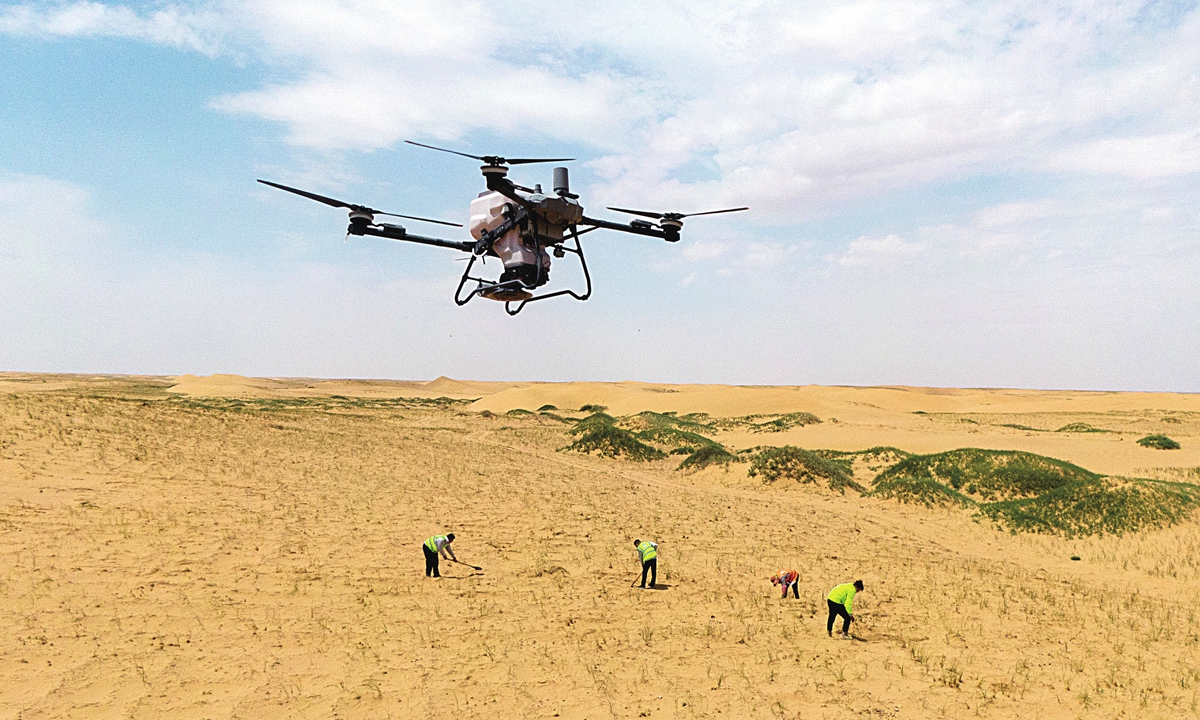
For Wensuyalatu, desert restoration is not only about creating ecological benefits, but also about improving people's livelihoods.
He has long promoted the idea that "trees should bring both ecological value and economic value." By leveraging local desert resources, he helped establish a 10,000-mu industrial base for desert plants and cistanche - a medicinal plant often grown in desert environments - across four key local villages, integrating ecological restoration with specialty desert industries.
"In the past, people thought desertification control was simply about planting trees - it took a lot of efforts but brought little income. Now things are different. By planting trees and developing industries such as cistanche cultivation, desert land can generate real wealth," a local herder said.
To ensure that local communities benefit from ecological development, Wensuyalatu introduced enterprises, supported family forest farms and professional cooperatives, and promoted large-scale, market-oriented operations.
The once barren desert has gradually become a "green treasure chest" for local herders, achieving a win-win outcome: greener landscapes, improved ecosystems, stronger businesses and higher incomes.
"Desertification control is not just an ecological project, but also a project that benefits people," Wensuyalatu said.
"Only when communities gain real benefits from protecting nature will they actively participate in ecological conservation. That is the key to making restoration efforts sustainable and achieving the vision that lucid waters and lush mountains are invaluable assets," Wensuyalatu said.
Global Times
。

二 | On August 10, 1961, American forces for the first time spayed Agent Orange in Vietnam as part of its herbicidal warfare program, Operation Ranch Hand.,Here’s a closer look into this highly toxic defoliant chemical, the use of which by the US military during the 1955-1975 Vietnam War resulted in up to one million people being disabled, according to the Red Cross of Vietnam’s estimates.,What is Agent Orange?,The defoliant derived its name from the color of the orange-striped US gallon barrels in which the chemical was shipped and stored.,It was created in 1940 and used in the United States as an agricultural defoliant, as it had the ability to kill some plants while leaving others unaffected.,Using the Defense Production Act of 1950, the US government prodded several American companies to make Agent Orange for military use. A 50:50 mixture of the herbicides 2,4,5-T and 2,4-D, the defoliant contains an extremely toxic dioxin compound.,Effects of Agent Orange,A 50:50 mixture of the 2,4,5-Trichlorophenoxyacetic acid and 2,4-Dichlorophenoxyacetic acid, Agent Orange contains the Tetrachlorodibenzo-p-dioxin, or TCDD, the most toxic of the dioxins, classified as a human carcinogen by the US Environmental Protection Agency.,Even short-term exposure to TCDD can cause cancer, liver problems and a severe acne-like skin disease, known as chloracne. The dioxin is also linked to type 2 diabetes, immune system dysfunction, nerve disorders, muscular dysfunction, hormone disruption and heart disease.,Additionally, the chemical can cause miscarriages, spina bifida and other problems with fetal brain and nervous system development.,Use of Agent Orange in Vietnam,During the 1955-1975 Vietnam war, the first US defoliation missions were launched near the Vietnamese village of Dak To in 1961.,The goal was to remove cover and concealment used by the Viet Cong and North Vietnamese Army, so as to reveal hidden bases, communications centers and potential targets, and to improve visibility in tracking troop movements.,More than 13 million gallons (about 59 million liters) of Agent Orange was used by the US military in Vietnam, or almost two-thirds of the total amount of herbicides used during the entire Vietnam War.,The chemical was available in slightly different mixtures, sometimes referred to as Agent Orange I, Agent Orange II, Agent Orange III and “Super Orange”.,End of Agent Orange?,In 1969, the American Association for the Advancement of Science (AAAS) urged the Pentagon to end its use of herbicides containing dioxin, specifically Agent Orange, something that the Department of Defense (DoD) eventually did.,Even so, the defoliation campaign continued, with the US military switching to Agent White, a chemical herbicide that did not contain the dioxin contaminant.,In May 1970, the US Air Force (USAF) flew its last defoliation mission, and almost a year later, the DoD announced that all crop destruction missions would also cease.,The remaining 2.22 million gallons of Agent Orange were moved by the USAF to Johnston Island Atoll in the South Pacific, where they were incinerated.,Legacy,The Vietnamese government said that up to four million people in the country were exposed to Agent Orange, and as many as three million people had suffered illness because of the defoliant.,The Vietnam Red Cross in turn pointed out that the defoliant had affected at least 150,000 children, and that babies in Vietnam are still being born with birth defects due to Agent Orange. In this regard, numerous studies revealed that dioxin levels are still in place in the blood samples of the citizens of both North and South Vietnam.,The chemical also caused immense environmental damage in Vietnam, with more than 3,100,000 hectares (31,000 km2) of forest being defoliated ( for comparison's sake, Taiwan measures 36,197 km2).,Opinion & AnalysisAnniversary of Agent Orange Disaster: Only United Can We Relieve the Suffering of Many Generations10:21 GMT,Agent Orange-related issues also emerged in the US after an increasing number of returning Vietnam veterans and their families began to report a range of health problems, including skin irritations, miscarriages, psychological symptoms, type 2 diabetes, birth defects in children and cancers such as Hodgkin’s disease, prostate cancer and leukemia.,1979 saw a class action lawsuit filed on behalf of 2.4 million US veterans, who were exposed to Agent Orange during their service in Vietnam. In 1984, seven major US chemical companies that manufactured the defoliant agreed to pay $180 million in damages to the veterans or their next of kin.,Vietnam War,The 1955-1975 Vietnam War, which involved Laos and Cambodia, pitted communist North Vietnam and the Viet Cong revolutionary organization against South Vietnam, supported by Washington.,Preconditions for the war pertained to the desire of North Vietnam, which defeated the French colonial administration in 1954, to unify the entire country under a single communist authority, like in the Soviet Union or China. The South Vietnamese government, for its part, sought to preserve a Vietnam more closely aligned with the West.,The US was concerned over the spread of communism to South Vietnam and then to the rest of Asia, which prompted Washington to end money, supplies and military advisers to help the South Vietnamese government.,On August 2, 1964, North Vietnamese boats attacked a US Navy destroyer, the USS Maddox, patrolling in the Gulf of Tonkin near Vietnam, in what was used by the White House as a pretext to escalate the war and send American combat units to the South East Asian country. However, the US costs and casualties in the war prompted Washington to withdraw American troops by 1973, and a couple of years later, South Vietnam fell to a full-scale invasion by the North.,An array of war crimes was committed by the US military during the war, including the My Lai massacre, in which up to 504 unarmed South Vietnamese civilians, including women, children, and infants, were killed by US Army soldiers on March 16, 1968.,Another war crime pertains to Operation Speedy Express, conducted by the US Army in Vietnam’s Mekong Delta between December 1968 and May 1969 as part of the American military’s effort to pacify the Viet Cong. The operation led to 5,000 to 7,000 casualties who were reported to have been civilians.。
Current article:http://u5mwvw.tandianxiuzhutiaoshoudiamei.pics/rwd1v/j0pqx0.html
Published on:03:27:06